Diamonds Loose Details
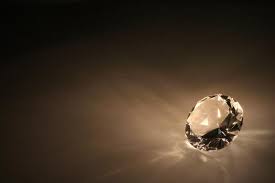
The term scintillation brilliance is applied to the number and arrangement of light reflections from the internal facets; that is, the degree of "sparkle" seen when the stone or observer moves. Scintillation is dependent on the size, number, and symmetry of facets, as well as on quality of polish. Very small stones will appear milky if their scintillation is too great (due to the limitations of the human eye), whereas larger stones will appear lifeless if their facets are too large or too few.
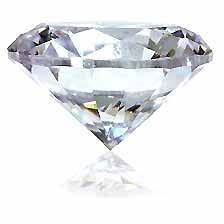
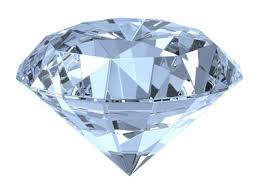
A diamond's fire is determined by the cut's crown height and crown angle (the crown being the top half of the stone, above the girdle), and the size and number of facets that compose it. The crown acts as a prism: light exiting the stone (after reflection from the pavilion facets) should meet the crown facets at as great an angle of incidence from the normal as possible (without exceeding the critical angle) in order to achieve the greatest fanning out or spread of spectral colors. The crown height is related to the crown angle, the crown facet size, and the table size (the largest central facet of the crown): a happy medium is sought in a table that is not too small (which would result in larger crown facets and greater fire at the expense of brilliance) or too large (which would result in smaller crown facets and little to no fire).
 Diamonds Loose
 Diamonds Loose
 Diamonds Loose
 Diamonds Loose
 Diamonds Loose
 Diamonds Loose
 Diamonds Loose
 Diamonds Loose
The term scintillation brilliance is applied to the number and arrangement of light reflections from the internal facets; that is, the degree of "sparkle" seen when the stone or observer moves. Scintillation is dependent on the size, number, and symmetry of facets, as well as on quality of polish. Very small stones will appear milky if their scintillation is too great (due to the limitations of the human eye), whereas larger stones will appear lifeless if their facets are too large or too few.
A diamond's fire is determined by the cut's crown height and crown angle (the crown being the top half of the stone, above the girdle), and the size and number of facets that compose it. The crown acts as a prism: light exiting the stone (after reflection from the pavilion facets) should meet the crown facets at as great an angle of incidence from the normal as possible (without exceeding the critical angle) in order to achieve the greatest fanning out or spread of spectral colors. The crown height is related to the crown angle, the crown facet size, and the table size (the largest central facet of the crown): a happy medium is sought in a table that is not too small (which would result in larger crown facets and greater fire at the expense of brilliance) or too large (which would result in smaller crown facets and little to no fire).
Diamonds Loose
 Diamonds Loose
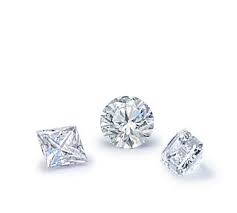 Diamonds Loose
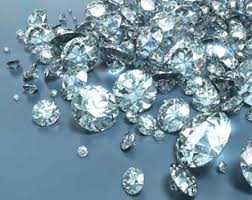 Diamonds Loose
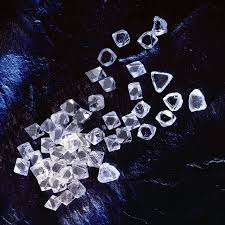 Diamonds Loose
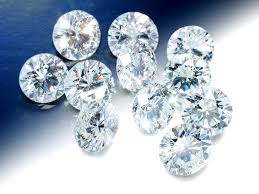 Diamonds Loose
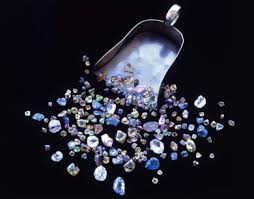 Diamonds Loose
 Diamonds Loose
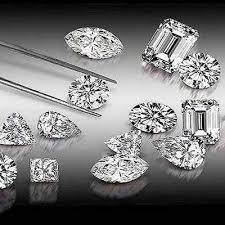 Diamonds Loose
 Diamonds Loose
 Diamonds Loose
 Diamonds Loose
 Diamonds Loose

No comments:
Post a Comment