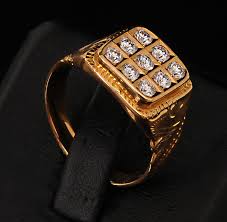
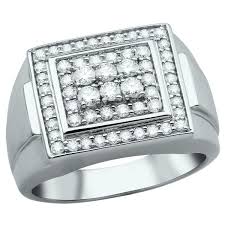
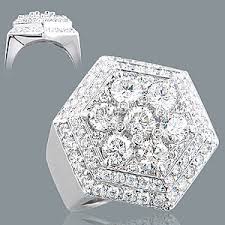
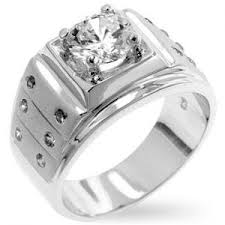
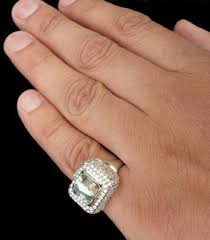
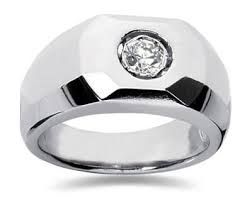
Mens Diamond Rings Details
Most "colorless" diamonds are actually tinted yellow or brown to some degree, whereas some artificial simulants are completely colorless—the equivalent of a perfect "D" in diamond color terminology. This "too good to be true" factor is important to consider; colored diamond simulants meant to imitate fancy diamonds are more difficult to spot in this regard, but the simulants' colors rarely approximate. In most diamonds (even colorless ones) a characteristic absorption spectrum can be seen (via a direct-vision spectroscope), consisting of a fine line at 415 nm. The dopants used to impart color in artificial simulants may be detectable as a complex rare earth absorption spectrum, which is never seen in diamond.
Also present in most diamonds are certain internal and external flaws or inclusions, the most common of which are fractures and solid foreign crystals. Artificial simulants are usually internally flawless, and any flaws that are present are characteristic of the manufacturing process. The inclusions seen in natural simulants will often be unlike those ever seen in diamond, most notably liquid "feather" inclusions. The diamond cutting process will often leave portions of the original crystal's surface intact. These are termed naturals and are usually on the girdle of the stone; they take the form of triangular, rectangular, or square pits (etch marks) and are seen only in diamond.











Most "colorless" diamonds are actually tinted yellow or brown to some degree, whereas some artificial simulants are completely colorless—the equivalent of a perfect "D" in diamond color terminology. This "too good to be true" factor is important to consider; colored diamond simulants meant to imitate fancy diamonds are more difficult to spot in this regard, but the simulants' colors rarely approximate. In most diamonds (even colorless ones) a characteristic absorption spectrum can be seen (via a direct-vision spectroscope), consisting of a fine line at 415 nm. The dopants used to impart color in artificial simulants may be detectable as a complex rare earth absorption spectrum, which is never seen in diamond.
Also present in most diamonds are certain internal and external flaws or inclusions, the most common of which are fractures and solid foreign crystals. Artificial simulants are usually internally flawless, and any flaws that are present are characteristic of the manufacturing process. The inclusions seen in natural simulants will often be unlike those ever seen in diamond, most notably liquid "feather" inclusions. The diamond cutting process will often leave portions of the original crystal's surface intact. These are termed naturals and are usually on the girdle of the stone; they take the form of triangular, rectangular, or square pits (etch marks) and are seen only in diamond.
Mens Diamond Rings
Mens Diamond Rings
Mens Diamond Rings
Mens Diamond Rings
Mens Diamond Rings
Mens Diamond Rings
Mens Diamond Rings
Mens Diamond Rings
Mens Diamond Rings
Mens Diamond Rings
Mens Diamond Rings
Mens Diamond Rings
Mens Diamond Rings
Mens Diamond Rings
Mens Diamond Rings
Mens Diamond Rings
Mens Diamond Rings
Mens Diamond Rings
Mens Diamond Rings
Mens Diamond Rings
Mens Diamond Rings

No comments:
Post a Comment